

Cybertruck Ownership · A Closer Look
The Cybertruck makes more sense up close.
If a friend sent you here, you’ve probably seen the stainless-steel triangle and wondered what the point is. I brought a tape measure and spent an afternoon showing what ours actually does for our family, along with the compromises.
The Quick Take
The shape gets the attention. Everyday usefulness is why we kept it.
For us, the appeal is the combination: a useful bed, room for three kids, easy maneuvering, home charging, and a driving experience I enjoy. The purchase price, long-distance towing compromises, and attention are part of that same decision. This is the case for our routine, with those tradeoffs left in.
Send This To A Friend
Send This to Your Friend Who Doesn’t Get the Cybertruck
Come along for the measurements, the storage tour, the driving experience, and the numbers behind my daily use. This is our 2026 Premium AWD, rather than the Cyberbeast.
01
A shorter truck can still have more bed.
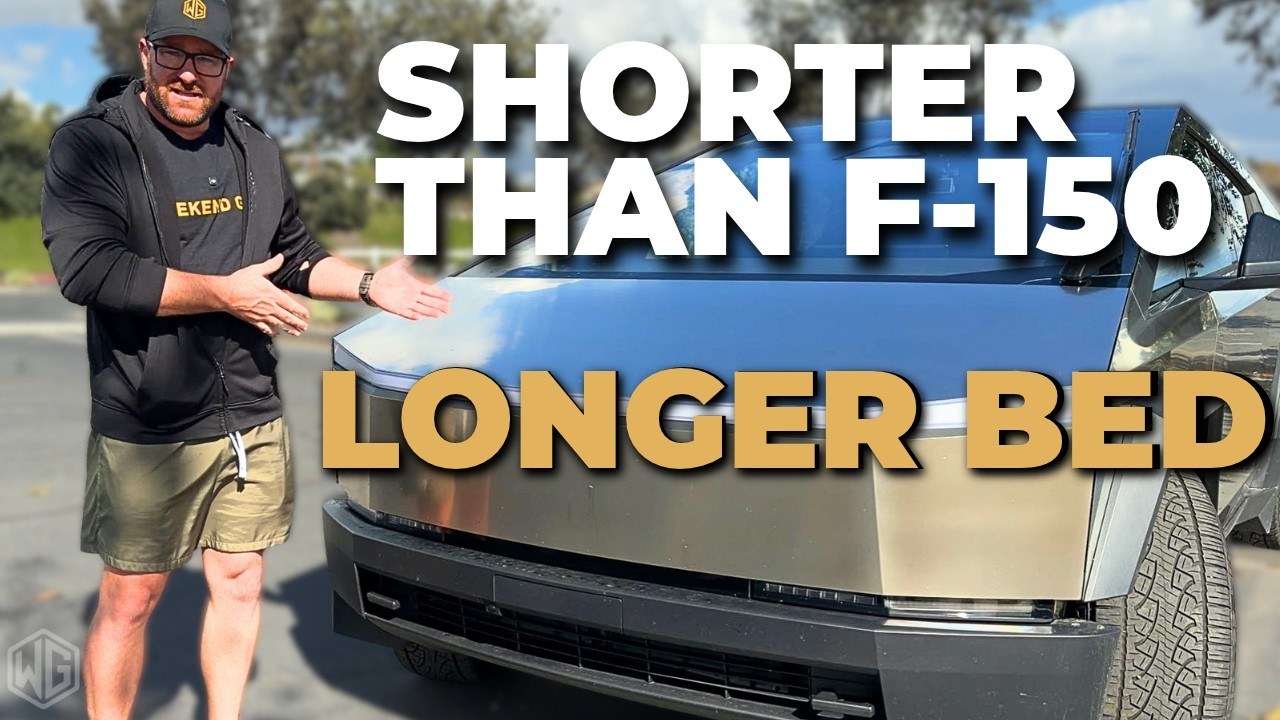
The shape makes it hard to judge the size from the road. In the video, I compare the Cybertruck’s 223.7-inch overall length with specific F-150 SuperCrew, Silverado crew-cab, and Tundra CrewMax short-bed configurations. Each of those examples is longer overall, while our truck has a six-foot bed.
That doesn’t make every parking space easy, or every pickup comparison identical. It explains one of the things people miss: the exterior footprint and useful bed length tell different stories. At 0:48 in the video, I walk through the comparison before getting the tape measure out.
02
The useful part is what fits, and where it goes.
I measure roughly 54 inches across the bed in the video, with no wheel arches taking up that space. A four-by-eight sheet of plywood fits across the width; its eight-foot length extends beyond the six-foot bed. That distinction matters if you’re picturing carrying a full sheet entirely inside with the tailgate closed.
The covered bed also works for sports chairs, groceries, and ordinary homeowner jobs. After an overnight rain, ours was dry when I opened it. That is one experience with our truck, rather than a waterproof guarantee. Under-bed storage and the frunk give us separate places for the rest of the family gear. The tour starts at 1:54.
03
The driving experience is usually my first answer.
Steer-by-wire and rear-wheel steering are a big part of why I like living with it. The size is still there, but parking lots, drive-throughs, and tight turns feel easier than I expected from a truck. The instant response of the electric drivetrain adds to that, even in our AWD rather than the Cyberbeast.
I also talk about how much I use Full Self-Driving (Supervised). It helps in our routine, and it still needs an attentive driver ready to take over. My enthusiasm for it isn’t a claim that it drives perfectly or removes that responsibility. Start with the steering discussion at 3:27, or read why FSD finally clicked for me.
04
Three kids give the storage a real job.
Two of our kids have sports gear. Our youngest brings scooters, stuffies, and her own version of equipment. I usually keep chairs and practice gear toward the back of the bed, with everyday shopping closer to the front. The frunk handles another set of errands without rearranging everything.
That is the practical reason this became our family truck: room for the people and places for what comes with them. For the rest of the family’s opinions, hear what my wife and kids think after five months. The storage and family section of this video begins at 9:01.
05
About 14 cents a mile, before solar.
For this video, I used 4,820 kWh charged over 8,863 miles and an assumed utility rate of $0.25 per kWh. That works out to about $1,205 in electricity, or 13.6 cents per mile. I rounded that to 14 cents.
The charging total includes charging losses and energy used while parked. I deliberately left our solar out of this estimate to show what that energy would cost at the stated utility rate. This is an electricity-cost calculation, rather than the full cost of owning the truck: it doesn’t include the purchase, insurance, tires, or depreciation. My earlier first-month charging story explains the different result when solar enters the picture. The updated explanation starts at 13:12.
06
The compromises are part of the answer.
Long-distance towing changes the equation. Range drops and charging stops take time; the towing comparison in this video is a modeled scenario based on other owners’ tests, rather than a trip I drove myself. If that is your normal use, it deserves its own homework.
Price matters too. I bought a premium truck, and cheaper gasoline pickups exist. Then there is being noticed: this is a hard vehicle to disappear into a parking lot with. For my commute, home charging, three kids, occasional truck jobs, and weekends out, the combination works. Someone with a different routine can reasonably land somewhere else.
Keep Going
Which part matters for your life?
Thinking about buying?
Start with the whole decision, including the doubts and the family conversation.
Follow our Cybertruck journey →Already living with one?
See the small fixes that made ours easier to use, with the testing notes and discount codes.
Charging, roof heat, and storage →